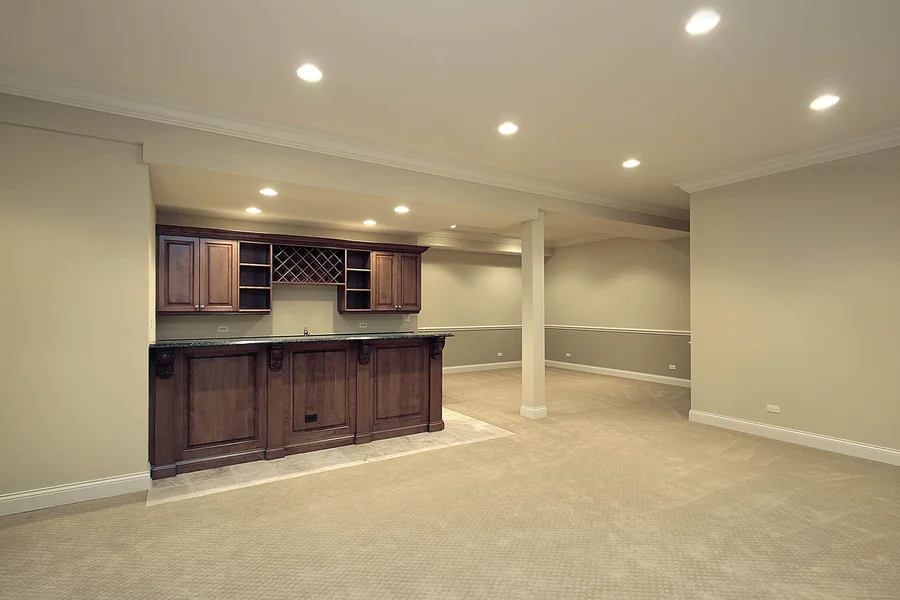
Why does a furnace that held a house at 70 degrees for eleven winters suddenly run most of the night after the basement gets finished? Because it is not the same house any more. A 1,650 square foot ranch in Conyers that picks up 750 finished square feet downstairs is now a 2,400 square foot heating load, and not one thing about the equipment in the utility closet changed to meet it. The upstairs thermostat reads whatever you set it to while the new lower level sits close to ten degrees under that, and on a 25 degree night the burner barely cycles off. That gap is what sends people looking for hvac repairs conyers ga during the first hard freeze, and the honest answer is usually a sizing correction rather than a failed part. A furnace has to be measured against the house as it exists now, not the house that was on the original plans.
Conditioned Square Footage Grew, The Load Calculation Did Not
A load calculation is arithmetic, not opinion. It takes floor area, ceiling height, insulation values, window area and orientation, air leakage, and the design temperature the county actually sees in January. Add finished space below grade and every one of those inputs moves at once. Basement walls give heat up to soil that sits in the fifties year round, the stairwell carries warm air up and away from the new rooms, and the return path for the lower level is often one undersized grille cut into a joist bay. The answer comes out in BTUs per hour, and the distance between what a 1,650 square foot ranch needed and what a 2,400 square foot one needs is not a rounding error.
Ten years ago the standard move on this call was to drop in the next size up off the truck and let the extra capacity cover the difference. That habit is fading. Two-stage and variable-speed equipment punishes a bad size far more visibly than an old single-stage unit ever did, and more permit offices now want a load calculation attached to the paperwork, though the rules vary by jurisdiction and are worth asking about before anyone quotes you. The measuring came first back then too. It just got skipped more often.
Measure These Four Numbers Before Adding Capacity
Four numbers settle most of these arguments, and a homeowner can collect three of them with a tape measure before anybody shows up. Start with finished conditioned square footage, counting only the space that is heated, which in the ranch example is 1,650 upstairs plus 750 down. Then ceiling height, because a 2,400 square foot house with nine foot ceilings holds a good deal more air than the eight foot assumption most quick estimates bake in. Third is the supply trunk feeding the new level, since a single six inch branch tapped off an existing trunk cannot deliver what those rooms need no matter how large the furnace gets. Fourth is the furnace output rating in BTUs per hour, stamped on the label and not the same number as its input rating. HVAC Base’s calculator, which I pulled up again in August 2026, starts from a baseline near 20 BTU per square foot and applies a climate zone multiplier of 1.00 to 1.10 for Zone 3 around Atlanta, which is enough to tell a homeowner whether the installed capacity is even in the neighborhood.
A furnace sized for 1,650 square feet will not heat 2,400 square feet, however well it has been maintained. What I cannot tell you from a description is how much of that ten degree gap belongs to the equipment and how much belongs to the ductwork. Nobody I know measures that split cleanly on a finished basement, and I would be suspicious of a contractor who quoted you a percentage on the spot. The case we run into most often is both at once, in some ratio that stays a guess until a technician puts a probe in the trunk and reads static pressure.
Right Sized Beats Bigger Every Winter
Right sizing is the boring answer and it is the one that holds up through a Georgia January. An oversized furnace short cycles and burns money staying ahead of a load it overshoots, while an undersized one never catches up on the ten or twelve genuinely cold nights, and both habits land on the same winter therm bill. The useful order is a measured load calculation first, then a look at whether the existing furnace and duct runs can be repaired or rebalanced to serve the new number, then replacement only if the arithmetic says so. So when the complaint is a cold lower level and the search says hvac repairs conyers ga, ask for the load numbers before you ask for the price. Finishing the basement changed the number. The equipment should be judged against the new one.