
Twelve inches of playground chips is a maintenance number, not a one-time purchase. Plenty of careful people treat it as the opposite, and the play area looks fine right up until a kid comes off a swing at full arc. If you keep a 900 square foot fenced backyard in Oregon City for a handful of daycare kids, the depth under the swing bay is the number to check before you order more mulch oregon city or yards deliver by the cubic yard. A tape measure settles it in under a minute. Ordering by measured depth and by cubic yardage costs less across a season than topping up by eye, and it is the only way to know the surfacing under your equipment is still doing the job you bought it to do.
Loose Fill Settles Below The Depth You Ordered
Wood chips compress. Feet, rain, freeze and thaw cycles and the plain weight of the pile all push material downward through a season, and the low spots form exactly where the traffic is heaviest rather than spreading themselves politely across the whole yard. Suppliers quote what the trade calls uncompressed depth, meaning the way material measures loose and fluffy on the day it lands, not the way it measures in August after four months of running feet. So the twelve inches spread in March is not the twelve inches sitting there now. The case we see most often is a backyard that was filled correctly, never touched again, and reads barely seven inches under the swings by the end of summer.
According to a Bob Vila mulch guide updated in May 2026, a premium brown wood mulch holds its color, cuts down on watering and suppresses weeds well, with red and black options if you want the beds to pop. That is a bed and border decision, though. Under the swings, color is worth nothing and depth is worth everything, which is why play surfacing gets bought on a different set of numbers than the landscaping twenty feet away.
Depth Under The Swings Decides The Cushion
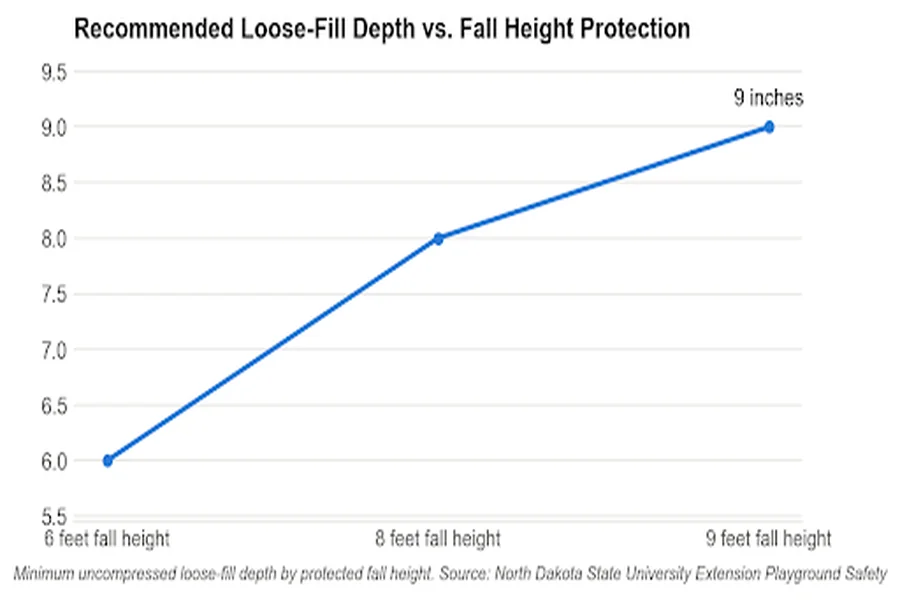
Surfacing is the only thing between a falling child and the ground, and the depth of it is what absorbs the impact. Deeper material protects a longer fall. That is why depth has to be matched to the fall height of the equipment above it: the higher the top rung or the swing seat, the more material has to be underneath, and the depth has to be maintained at that level year round rather than restored once a year. Measure at the worst spot, never the average one. Chips scatter fastest under the swing bay and at the bottom of a slide, and those are the two places a hard landing actually happens. If a child does hit their head, have them seen by a doctor right away, no matter how deep the chips looked when you last checked.
Ask A Chip Supplier These Five Questions
A short phone call sorts a real bark and chip yard from an outfit that will drop a load in the driveway and drive off. Anyone selling mulch oregon city or daycares put under swings should be able to answer five questions without stalling, because they field them every spring. Write the answers down, since the yardage figure is the one you will want again next year.
- How many cubic yards does 900 square feet at twelve inches actually take? A good answer does the arithmetic out loud and lands near 33 yards.
- Is the depth you quote measured loose, or after it settles? A good answer says uncompressed and suggests ordering extra to cover compaction.
- What species is the chip, and is the load screened? A good answer names the wood, cedar for instance, and says the load is screened for sticks and fines.
- Is there a minimum load, and what does delivery add on top? A good answer gives both numbers before you commit to anything.
- What is the real lead time in April and May? A good answer is honest about the spring backlog, usually a few days rather than same day.
Money matters here too, because a full fill is the biggest single line on a small play area budget. Say the spring load runs about $900 delivered against a $1,200 seasonal materials budget. Honestly, closer to $1,050 once the smaller midsummer top-up load goes in, and that second load is the one almost everybody forgets to plan for.
Top Up On A Schedule, Not On Sight
Put the measurement on a calendar instead of trusting your eye, because the eye grades on a curve and the tape measure does not flatter anyone. Check the swing bay and the slide exit in March, again in July, and once more before the wet season sets in, writing the number down each time so the drift is visible instead of remembered. North Dakota State University Extension sets the floor at 12 inches of loose-fill surfacing under playground equipment and notes that loose fill compresses at least 25 percent over time from use and weather. Order against the compressed number, not the fresh one.
The practical version fits on an index card. Measure three spots, convert the shortfall to cubic yards, order that volume from a supplier who quotes depth rather than guessing at it, and repeat before the next busy season. Guesswork costs more over a year than a scheduled top-up does, and it is the only one of the two that leaves a child landing on packed ground in August.