Welding is one of those trades where the margin between excellent and adequate often comes down to gear. A skilled welder with poor equipment will consistently underperform compared to someone with the right tools for the job. Nowhere is this more true than with welding lenses. The lens sitting between a welder's eyes and a 6,000-degree arc is not a minor accessory. It is a critical piece of safety equipment that directly affects arc visibility, eye protection, and the quality of the finished weld. Yet lens selection remains one of the most underappreciated decisions a professional welder makes.
The Science Behind Welding Lens Shade Numbers
Every welding lens is rated with a shade number, and understanding this scale is foundational to making good lens choices.
Shade numbers run from 1 (very light) to 14 (extremely dark), with welding applications typically requiring shades in the 9 to 13 range. The shade number represents how much visible light the lens filters out. A shade 10 lens, for example, transmits roughly 0.01% of ambient light, while a shade 13 blocks even more.
Choosing the wrong shade has real consequences:
- Too dark: The welder struggles to see the puddle clearly, leading to poor bead control and wasted material
- Too light: Harmful UV and infrared radiation reach the eyes, causing short-term arc flash and long-term retinal damage
- Correct shade: Clear visibility of the weld pool, surrounding base metal, and joint geometry while maintaining full eye protection
The appropriate shade also depends on the welding process. TIG welding on thin aluminum might call for a shade 9 or 10, while stick welding at high amperage typically requires a shade 12 or 13. Experienced welders develop strong personal preferences within these ranges based on their visual acuity and the specific work they perform.
Auto-Darkening Lenses vs. Passive Lenses: A Practical Comparison
For decades, welders used passive lenses, fixed-shade glass that required lifting the hood to inspect the joint before striking an arc. Auto-darkening lenses changed the equation entirely.
How Auto-Darkening Technology Works
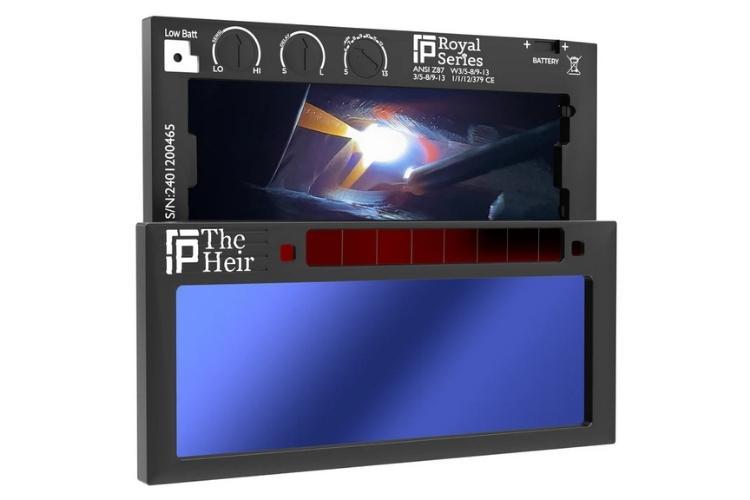
Auto-darkening lenses contain a liquid crystal panel that switches from a light state (typically shade 3 or 4) to a dark state in milliseconds when sensors detect arc light. This allows the welder to position themselves precisely, view the joint clearly, and strike without repositioning.
Key Differences to Consider
- Speed: Switching time matters. Slower lenses can expose the eyes to a fraction of a second of unfiltered arc light during each strike
- Sensitivity: High-quality lenses adjust sensitivity for different environments, preventing false triggering from ambient light or shop lighting
- Solar vs. battery power: Battery-dependent lenses can fail mid-job; solar-assisted models add reliability
- Viewing area: A larger viewing area reduces eye strain during long shifts and improves situational awareness
Professional welders working long days, particularly in pipeline and structural applications, often prioritize auto-darkening lenses precisely because the reduced neck strain and improved positioning control add up over a full workday.
Specialty Lenses: Gold, Silver, and Cobalt Blue
Standard green-tinted lenses have been the industry default for generations, but specialty color-filtered lenses have gained significant traction among professional welders who want better arc definition and contrast.
Ridge Products Welding, available at https://ridgeproductswelding.com/, has built much of its reputation on offering exactly this kind of specialized product, catering to experienced craftsmen who have moved beyond generic off-the-shelf gear and want lenses tuned to specific tasks and visual preferences.
Gold Lenses
Gold lenses use an infrared-reflective coating that reduces heat transmission to the eyes. Welders working in high-heat environments often report reduced eye fatigue with gold lenses compared to standard options. The gold tint also enhances contrast in certain welding conditions.
Silver Lenses
Silver lenses offer a neutral, high-contrast view of the arc and weld pool. Many welders find the silver tint easier on the eyes during extended sessions, as it reduces the color distortion that can come with heavily tinted alternatives.
Cobalt Blue Lenses
Cobalt blue lenses are popular in specific applications, particularly gas welding and brazing, where the blue filter cuts through the sodium flare produced by the flux. This makes it easier to see the actual weld puddle rather than being blinded by the bright yellow-orange flare.
Understanding which lens color suits a given process is part of what separates a welder who gets by from one who consistently produces high-quality work.
The Role of the Hood in Lens Performance
A lens does not exist in isolation. The helmet or hood that houses it has a major influence on how well the lens performs in the field.
Hood Fit and Stability
A hood that shifts during work causes the lens to move out of the optimal viewing angle. This is particularly problematic during overhead or out-of-position welding where maintaining a consistent line of sight to the puddle is already challenging.
Specialized Hood Designs
Certain hood designs serve specific applications far better than general-purpose helmets:
- Sugar Scoop hoods: Designed for welders who work in tight spaces or need a more angled forward view
- Pipeliner hoods: Built for the demands of pipeline welding, where welders frequently work in awkward positions for extended periods and need a hood that stays secure
Ridge Products Welding serves this exact market, offering both hood styles alongside their lens products to ensure that professional welders have a complete and compatible system rather than mismatched components.
Maintaining Your Welding Lenses
Even the best lens degrades if not maintained properly.
- Inspect the lens regularly for pitting, scratches, or spatter buildup that can distort vision
- Use cover lenses on both sides of the welding lens to extend its life and protect the optical surface
- Store lenses away from direct sunlight when not in use, particularly for auto-darkening models where UV exposure can degrade the liquid crystal panel over time
- Test auto-darkening function before starting any job by striking a test arc or using the included test button if available
Replacing worn lenses is not an optional expense. A degraded lens compromises both safety and weld quality simultaneously.
Putting It All Together
Lens selection is a technical decision, not a shopping preference. The shade number, darkening speed, color filtration, and hood compatibility all interact to affect what a welder sees and how well their eyes are protected over a career. Taking this decision seriously pays dividends in weld quality, reduced eye fatigue, and long-term eye health.
For welders ready to move past generic equipment, exploring purpose-built options designed specifically for professional applications is a logical next step. The right lens, in the right hood, matched to the right process, makes a measurable difference from the first arc to the last.