Artificial intelligence has rapidly become part of everyday workplace operations. Businesses now use AI to draft emails, summarize documents, analyze information, assist with research, generate reports, review code, and automate repetitive administrative work. These tools can reduce the amount of time employees spend on routine tasks and allow teams to focus on more valuable activities.
However, being able to automate a task does not necessarily mean that it should be completely automated. AI can process large amounts of information quickly, but it does not carry human responsibility, understand every piece of organizational context, or reliably recognize the consequences of a poor decision. Resources such as https://evostai.com/ focus on practical workplace AI use, including where AI tools are helpful, where they can fail, and why their outputs should be checked before businesses rely on them.
The most effective workplace strategy is therefore not simply human versus AI. It is finding the right balance between automation and human judgment.
Hiring and Recruitment Decisions
AI can make recruitment significantly faster. It can organize applications, summarize resumes, identify relevant qualifications, prepare interview questions, and help recruiters manage large candidate pools. These capabilities are particularly useful when a company receives hundreds or thousands of applications.
The final hiring decision, however, should never be handed entirely to an automated system. Hiring involves qualities that may not be accurately represented by keywords or historical data. Communication skills, motivation, adaptability, professional attitude, and potential can require human evaluation.
There is also the possibility of systematic bias in automated decision-making. If an AI system learns from historical hiring patterns or relies heavily on incomplete information, it may unintentionally favor certain profiles. Human recruiters should therefore use AI as an assistant while maintaining responsibility for evaluating candidates and making final employment decisions.
Employee Performance Evaluations
Performance reviews are another area where AI can provide useful support without becoming the final decision-maker. AI can organize performance data, summarize project activity, identify trends, and help managers prepare structured evaluation documents.
But employee performance cannot always be reduced to measurable data. An employee may have helped colleagues solve difficult problems, handled an unhappy customer professionally, trained new team members, or contributed ideas that are difficult to capture through standard metrics.
Allowing an automated system to determine promotions, bonuses, disciplinary action, or termination could overlook important context. Managers should review AI-generated analysis, speak with employees, consider qualitative contributions, and make the final decision themselves.
High-Stakes Financial Decisions
AI is increasingly useful in finance because it can analyze transactions, detect unusual patterns, prepare forecasts, categorize expenses, and identify possible risks. These capabilities can help finance teams work more efficiently.
Nevertheless, major financial decisions should retain meaningful human oversight. Approving a significant investment, rejecting an important transaction, changing a company budget, extending substantial credit, or making decisions that affect someone’s financial future can have serious consequences.
AI may identify patterns without fully understanding unusual circumstances behind them. Human financial professionals can investigate exceptions, question assumptions, and consider business conditions that may not appear in the available data.
Legal and Compliance Decisions
AI can save substantial time when reviewing contracts, summarizing regulations, comparing documents, or locating potentially relevant clauses. For legal teams, it can be an effective first-pass research and document-processing tool.
It should not independently make important legal decisions. AI-generated information can be incomplete, outdated, incorrectly interpreted, or presented with more confidence than its accuracy deserves. A small error in a contract, regulatory filing, compliance decision, or legal interpretation could create significant consequences for an organization.
Qualified professionals should verify important legal information and determine the appropriate action. The higher the potential consequences of an error, the more important human review becomes.
Sensitive Employee Conversations
Some workplace responsibilities require empathy rather than processing power. Conversations involving layoffs, disciplinary action, workplace conflicts, harassment complaints, personal difficulties, or serious performance problems should not be completely automated.
AI can help managers prepare talking points, organize documentation, or draft follow-up communication. However, employees deserve the opportunity to communicate with another person when discussing issues that significantly affect their careers or well-being.
Tone, timing, body language, cultural differences, and emotional reactions can change how a conversation should proceed. A human manager can respond dynamically in ways that automated communication may struggle to reproduce appropriately.
Final Customer Complaint Resolution
Customer service is one of the strongest applications for automation. AI assistants can answer common questions, provide basic troubleshooting, explain policies, and route support requests to appropriate departments.
Problems arise when businesses attempt to automate every customer interaction. Complex disputes, unusual billing problems, repeated service failures, account restrictions, and high-value customer complaints often require human judgment.
A chatbot repeatedly providing the same irrelevant answer can quickly turn a manageable problem into customer frustration. Businesses should create clear escalation paths so customers can reach a human representative when automated support cannot resolve the issue.
Cybersecurity and Critical System Actions
AI can help cybersecurity teams analyze logs, identify suspicious behavior, prioritize alerts, and detect patterns that would be difficult for humans to monitor continuously. Automation is especially valuable because security teams may receive enormous numbers of alerts.
However, automatically taking major actions based on every AI-generated warning can create another type of risk. A false positive could block legitimate users, interrupt important business services, remove necessary data, or shut down systems.
For critical actions, organizations should define approval thresholds. AI can identify and prioritize potential threats, while qualified professionals review high-impact actions before execution whenever circumstances allow.
Strategic Business Decisions
AI is excellent at helping executives explore information. It can compare scenarios, summarize competitors, organize market research, analyze customer feedback, and generate possible strategies.
But business strategy involves uncertainty. Leadership teams must consider company culture, reputation, relationships, employee capabilities, customer expectations, financial risk, and long-term objectives. Not all of these factors can be captured accurately in a dataset or prompt.
Executives can use AI to challenge assumptions and explore alternatives, but responsibility for major strategic decisions should remain with people who understand the organization and will be accountable for the outcome.
Creative Work That Defines Brand Identity
AI can generate marketing concepts, headlines, social media drafts, product descriptions, and design ideas extremely quickly. For brainstorming and first drafts, this can dramatically increase productivity.
Yet completely automating brand communication can make content feel generic or inconsistent. A company’s voice develops through its values, audience relationships, history, and understanding of cultural context.
Human editors and creative professionals should therefore remain involved in important campaigns and public communication. AI can accelerate production, while people protect originality, accuracy, and brand identity.
Where AI Automation Makes the Most Sense
The safest opportunities for extensive automation are generally repetitive, predictable, and easily reversible tasks. Formatting standard reports, categorizing routine information, scheduling recurring processes, creating first drafts, transcribing meetings, or organizing structured data can often be heavily automated.
The calculation changes when a task involves people, significant money, legal consequences, safety, reputation, privacy, or irreversible actions. In these situations, AI should usually recommend, summarize, detect, or assist rather than make the final decision.
This approach also makes verification part of the workflow instead of treating AI output as automatically correct. Evostai’s workplace guidance similarly emphasizes checking AI answers before relying on them and matching the amount of verification to the stakes involved.
The Future Is Human-AI Collaboration
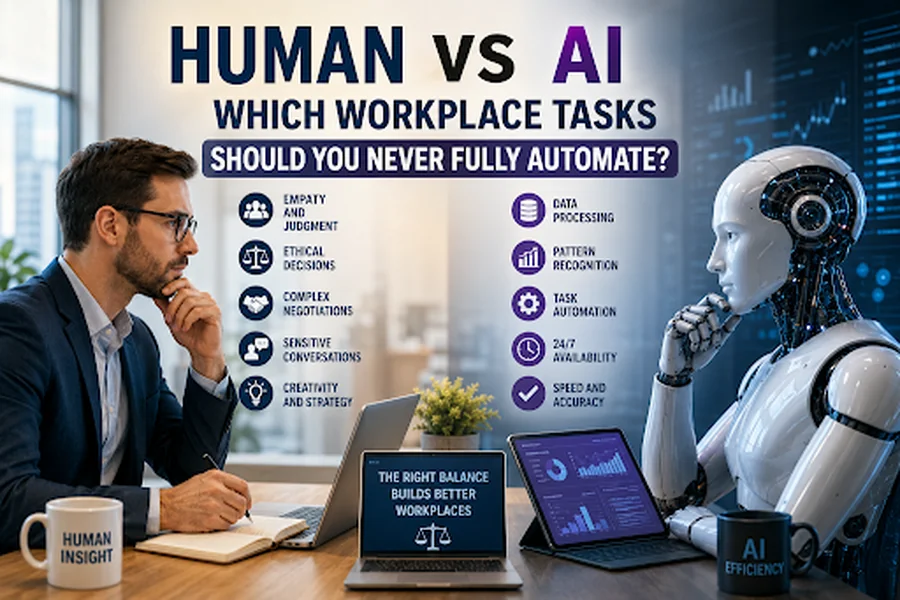
The workplace debate should not be framed as choosing humans or AI. Each has different strengths. AI provides speed, scale, consistency, and powerful information-processing capabilities. Humans provide accountability, contextual understanding, empathy, ethical judgment, and the ability to deal with unusual situations.
Organizations can achieve better results by designing workflows where each side performs the work it handles best. AI can complete the repetitive first pass, identify patterns, generate drafts, and present possible options. Humans can verify important information, handle exceptions, communicate sensitive decisions, and approve actions with serious consequences.
The goal of workplace automation should not be removing humans from every process. It should be removing unnecessary work while preserving human judgment where judgment matters most. Companies that understand this distinction can gain the productivity benefits of AI without giving up the accountability and thoughtful decision-making that responsible businesses still require.