When a critical industrial component fails—whether a turbine casing, pump shaft, or hydraulic cylinder—plant managers face a tough call: repair the part or purchase a replacement? Unscheduled downtime quickly drains capital, bottlenecks lines, and jeopardizes delivery commitments.
Rushing to replace can mean waiting months for long-lead components while paying steep freight fees. Conversely, attempting a quick patch on a part suffering from deep fatigue risks catastrophic secondary failure. Making the right call requires evaluating lead times, lifecycle economics, damage severity, and precision machining capabilities.
1. Evaluating Total Lead Time and Production Downtime
Quick Answer: If replacement lead times exceed the downtime window that your production schedule can tolerate, precision reconditioning or machining is almost always the superior choice.
Supply chain bottlenecks remain a constant hazard. For standard, off-the-shelf valves, replacement is fast. However, for custom or large-format machinery, lead times for new cast parts stretch from 12 to 26 weeks.
When calculating the cost of waiting, use an equipment downtime cost calculation that factors in:
- Lost Output: Direct revenue loss caused by stalled operations.
- Idle Labor: Paying operations staff while production sits dormant.
- Contract Penalties: Fines or damaged customer relationships resulting from delayed shipments.
If an expert machining partner can restore an existing component within days, repairing drastically limits financial loss compared to waiting on a new casting.
2. The 50 Percent Rule: Financial Break-Even Analysis
Quick Answer: If the cost to recondition and recertify a part is less than 50 to 60 percent of a new component’s purchase price—and restores at least 80 percent of its operating lifespan—repairing is economically sound.
In industrial maintenance, the “50 Percent Rule” provides a benchmark for capital decisions. If rebuilding an asset exceeds half the price of buying new, replacement is generally warranted—assuming a replacement is available.
However, purchase price alone does not reflect total cost. A rigorous industrial equipment lifecycle analysis accounts for:
- Tear-Down Labor: Machinery disassembly costs the same whether installing new or refurbished parts.
- Secondary Modifications: New components frequently come with slight dimensional changes requiring piping adjustments.
- Expected Life: Precision repairs restoring original tolerances deliver operational lifespans comparable to new OEM units.
3. Structural Integrity and Severity of Component Damage
Quick Answer: Surface wear, bore misalignment, and minor pitting are prime candidates for refurbishment, whereas deep thermal cracking or pervasive metallurgical fatigue demands replacement.
Not all component wear can—or should—be repaired. Deciding between salvage and scrap comes down to non-destructive testing (NDT) and metallurgical integrity.
- Prime Candidates for Repair: Worn bearing seats, scored shaft journals, localized galling, and oversized bore openings. These can be built up via weld overlay and re-machined to original tolerances.
- When Replacement Is Non-Negotiable: Pervasive stress cracking across load-bearing sections, severe heat-checking in pressure vessels, or severe embrittlement that permanently compromises base metal integrity.
4. Precision Machining and Boring: Restoring Large-Format Components
Quick Answer: Advanced industrial machining techniques allow massive heavy-duty components to be bored, sleeved, and surfaced back to original OEM specifications at a fraction of replacement cost.
Many maintenance leaders assume that once massive housings, gearboxes, or cylinder barrels suffer bore distortion, they must be scrapped. In reality, modern machining makes salvaging heavy industrial assets practical and cost-effective.
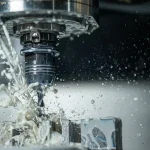
Utilizing specialized large diameter boring services allows machine shops to re-true misaligned bearing journals, repair oversized internal diameters, and machine massive industrial housings back to tight tolerances. Pairing weld build-ups with precision boring restores structural alignment on parts that would otherwise cost hundreds of thousands of dollars to replace.
5. Technology Upgrades and Energy Efficiency Considerations
Quick Answer: If replacing an obsolete part enables significant gains in energy efficiency, automation integration, or reduced emissions, replacement justifies the upfront capital expense.
Maintenance decisions should not happen in a vacuum. Sometimes, repairing an older part simply locks your plant into outdated, energy-inefficient technology.
Consider modernizing if:
- The Part Is Obsolete: Sourcing sub-components for an outdated assembly is becoming progressively harder.
- Efficiency Gains Are Significant: Newer pump, compressor, or motor designs feature advanced fluid dynamics that cut electricity costs by 15 to 30 percent.
- Compliance Standards Have Changed: Upgrades bring equipment in line with modern safety or environmental regulations.
6. Myth vs. Fact: Industrial Component Repair
- Myth: A repaired industrial part is always weaker than a new OEM part.
- Fact: High-quality precision component refurbishing—combining modern overlays and CNC machining—often exceeds original factory durability.
- Myth: Replacing a part is always the safest option for avoiding downtime.
- Fact: Lead-time volatility, transport delays, and unexpected fitment mismatches make new parts riskier for tight schedules.
- Myth: Discarding worn parts is cheaper than paying for specialized labor.
- Fact: The raw material value in heavy steel parts makes precision restoration significantly more cost-effective.
Frequently Asked Questions
What testing methods verify if an industrial part is repairable?
Technicians routinely employ magnetic particle inspection, dye penetrant testing, and ultrasonic thickness gauging to detect hidden subsurface cracks and confirm structural soundness before authorizing repairs.
How do warranty terms compare between repaired and replacement parts?
Reputable industrial reconditioning facilities offer warranties matching OEM coverage on remanufactured areas, typically ranging from 6 to 12 months of service.
Deciding whether to repair or replace industrial parts is a strategic balance between capital cost, production schedules, and structural reliability. While standard components favor quick replacement, high-value industrial machinery yields substantial savings in time and budget when reconditioned by precision machinists.
By calculating downtime costs, applying the 50 percent rule, inspecting metallurgical integrity, and leveraging modern boring and refurbishing technologies, you can make confident maintenance decisions. Taking a calculated approach ensures your plant minimizes disruptions and maximizes the working lifespan of critical equipment.