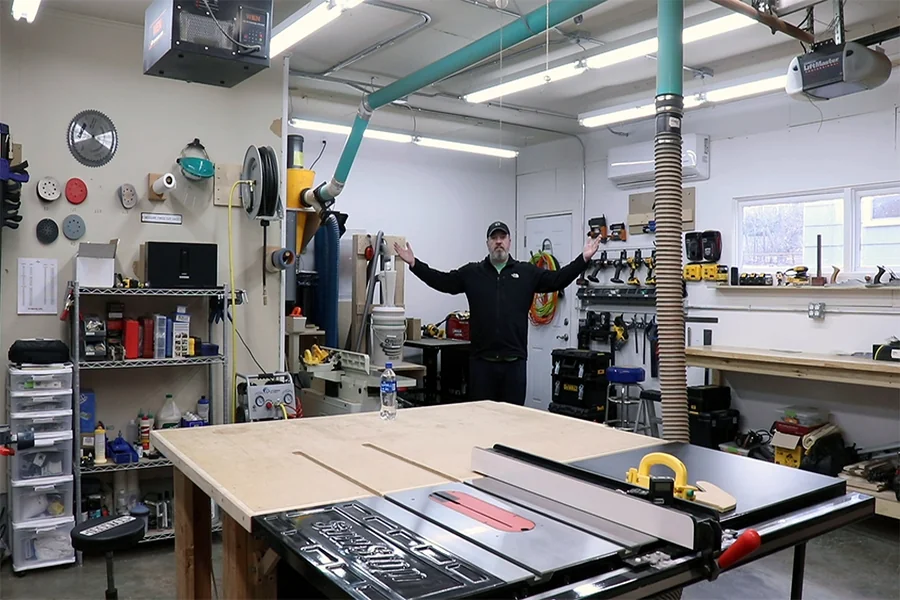
Count the tools. Count the outlets. Count the amps those tools actually pull in the half second they start. A Bradenton homeowner converting a garage into a working shop usually calls an electrical contractor bradenton fl only after the shop lights dim every time the compressor kicks on, which is late. That dimming is the panel telling you something. The argument here is simple: a real load calculation done before the first tool gets bolted to a wall turns a guess about capacity into a costed subpanel plan, and it is the cheapest hour in the entire project.
Garage Tools Draw More Power Than Owners Assume
A 5 horsepower compressor on a 240 volt circuit pulls in the neighborhood of 24 amps while it runs, and it demands considerably more for the instant the motor spins up. That spike is what dips the lights. Add a 15 amp table saw, a 10 amp dust collector running at the same time, and a small heater on a January morning, and the garage is asking for far more than the two general purpose circuits the builder ran out there when the house went up. Electrical Safety Foundation International said in its June 2026 home electrical safety guidance that lights dimming when another device switches on point to insufficient circuit capacity or an overloaded system, which is exactly the symptom most workshop owners learn to live with instead of measure.
Job after job, the same thing turns up. The service has headroom and the branch circuit does not.
The Load Calculation Decides The Whole Budget
Here is the arithmetic for a 1,900 square foot Bradenton house on a 150 amp panel. General lighting and receptacles get figured at 3 volt-amps per square foot, so 5,700 VA, plus 3,000 VA of small appliance circuits and 1,500 VA for laundry, which totals 10,200 VA before the big loads. Add a 12,000 VA range, a 5,000 VA dryer, a 4,500 VA water heater and a 5,000 VA air conditioner, and the raw total comes to 36,700 VA. The optional method counts the first 10,000 VA at full value and everything above it at 40 percent, so 10,000 plus 10,680 works out to 20,680 VA, which is roughly 86 amps at 240 volts. That leaves about 64 amps of headroom on the service, which is why a 60 amp garage subpanel usually fits without anybody touching the meter.
The same math decides what else can share the garage later. The U.S. Department of Energy’s Alternative Fuels Data Center treats home charging equipment as a continuous load under the National Electrical Code, installed by a certified electrical contractor on a circuit sized to code and permitted by the local authority. Any electrical contractor bradenton fl homeowners hire should ask about a future car charger before quoting the feeder, because copper pulled twice costs twice. If the charger is coming, size the subpanel for it now.
Inspection First Keeps The Subpanel Quote Honest
An honest subpanel number starts with somebody opening the panel that is already there. Grounding and bonding get tested, breakers get checked for heat and corrosion, and any oddity in the original branch wiring gets flagged before it turns into the surprise line item halfway through the job. Whole-house surge protection is worth pricing at that same visit, since it mounts in a panel that is already open and a shop full of motors and electronics is what it protects. Warm breakers, a breaker that trips again right after a reset, or scorch marks around an outlet mean stop using that circuit and call a licensed electrician. Do not reset it and keep cutting.
A woodworker off 53rd Avenue West ran his planer and his shop vacuum from one circuit for two years and simply learned to stagger them. The breaker started tripping midcut the week he added a bench sander. What he wanted to buy was another outlet, and what he actually needed was capacity, which an inspection would have told him for the price of a service call.
Spend On Capacity Instead Of Extension Cords
Say the finished 60 amp subpanel lands somewhere in the $2,000 to $3,000 range once feeder, breakers, labor and permit are counted, which is the shape of the number in Manatee County rather than a quote. Set that against the cost of doing it the other way: cords across a floor you walk on with a saw running, tools that never reach full torque, and an afternoon of emergency rewiring the week a breaker finally quits. Generators are their own Gulf coast conversation, and every June somebody asks about an interlock kit before they have asked how many amps the house can spare. Back to the panel. Run the load calculation, get the inspection, then buy exactly the capacity the numbers call for and not one breaker more.