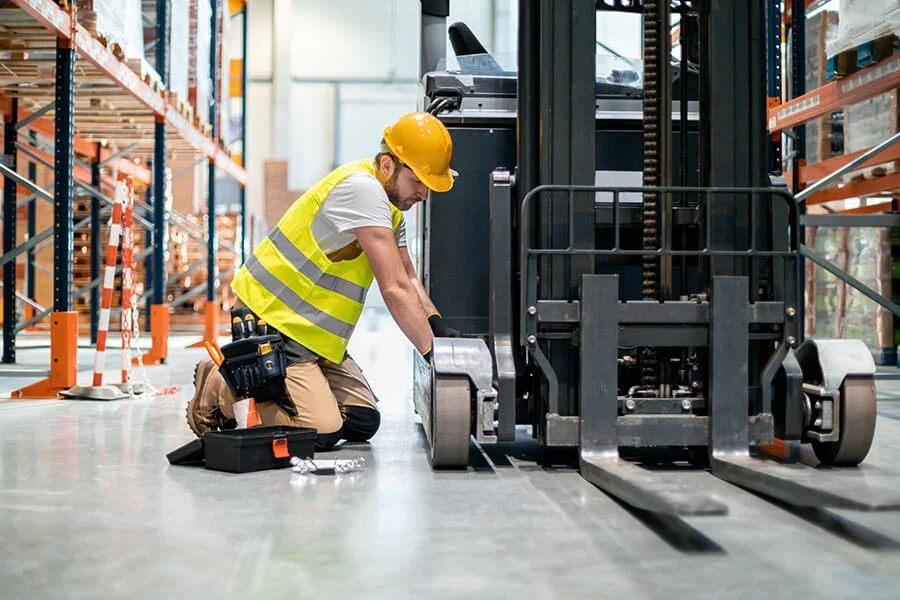
Every warehouse eventually faces the same question: do you keep repairing an ageing forklift, or is it finally time to replace it?
It sounds straightforward, but in practice the decision is rarely just about the latest repair quote. A truck that still runs may be costing more than it appears through downtime, safety risks, lower productivity, and rising maintenance needs. On the other hand, replacing equipment too early can tie up capital that would be better used elsewhere in the operation.
The right answer depends on how the forklift is used, what it costs to keep it productive, and whether it still supports the pace of your business. If you approach the choice methodically, you can avoid both extremes: throwing good money after bad or replacing a perfectly serviceable asset before its time.
Look Beyond the Repair Bill
The first mistake many operators make is comparing a repair invoice with the purchase price of a new forklift and stopping there. That’s not a fair comparison.
A repair is a short-term cost. A replacement is a long-term investment. To evaluate them properly, you need to look at total cost of ownership.
The Hidden Cost of “Keeping It Going”
An older forklift may still start every morning, but that doesn’t mean it’s cheap to run. Costs often show up in less obvious ways:
- unplanned downtime that interrupts shifts
- slower lifting or travel performance
- more frequent callouts from engineers
- rising parts costs, especially for discontinued models
- increased safety concerns or compliance issues
If one truck goes down repeatedly in a busy operation, the impact is rarely limited to that single machine. Picking slows, trailers wait longer, operators reshuffle priorities, and managers spend time solving avoidable problems. In a tight logistics environment, that disruption can cost more than the mechanical work itself.
Usage Matters More Than Age Alone
A ten-year-old forklift in a light-duty environment may still have plenty of value. A five-year-old truck running intensive multi-shift operations may already be approaching the point where replacement deserves serious consideration.
That’s why hours of use, maintenance history, and application matter more than age in isolation. A truck used occasionally for low-intensity tasks has a very different lifecycle from one working hard every day on demanding warehouse floors or outdoor yards.
Around this point in the evaluation, many fleet managers find it useful to compare their situation against a structured framework such as this forklift repair vs replacement guide, which helps break the decision down into cost, condition, and operational impact rather than instinct alone.
When Repair Still Makes Sense
Repair is often the smarter choice when the truck remains fundamentally sound and the issue is isolated rather than systemic.
Signs the Forklift Is Worth Repairing
If the mast, chassis, powertrain, and core systems are still in good condition, a targeted repair can extend useful life at a sensible cost. This is especially true when:
- the forklift has a reliable service record
- replacement parts are readily available
- downtime has been minimal until now
- the repair addresses a one-off failure rather than a pattern
- the truck still meets operational and safety requirements
For example, replacing tyres, sorting a hydraulic leak, or repairing a starter motor on an otherwise dependable truck is very different from dealing with recurring transmission problems, electrical faults, and escalating engine issues all within the same year.
A good rule of thumb is to ask whether the repair restores confidence or merely buys time. If it genuinely resets the truck for another stable period of service, repair may be justified. If it simply delays the next breakdown, it may not be.
When Replacement Becomes the Smarter Move
There comes a point when repairs stop being economical, even if the truck can technically be fixed.
Recurring Downtime Is a Red Flag
Repeated failures are often the clearest sign that replacement should be on the table. One major breakdown can happen to any machine. A series of failures usually suggests deeper wear across multiple systems.
That pattern matters because maintenance costs tend to accelerate, not stay flat. Once major components begin reaching end of life, the next invoice is seldom the last.
Safety, Efficiency, and Compatibility
Replacement also becomes more compelling when older trucks no longer align with the operation around them. That could mean:
- insufficient lifting capacity for current workloads
- poor energy efficiency compared with newer electric models
- outdated safety features
- incompatibility with narrower aisles or revised layouts
- operator discomfort affecting productivity over long shifts
In many businesses, the replacement decision is not driven by failure alone but by operational change. If your warehouse has evolved, your equipment may need to evolve with it.
A Practical Way to Make the Call
The best decisions usually combine hard numbers with operational judgement.
Start With the Maintenance Trend
Look at the last 12 to 24 months of service costs. Are repairs stable, or are they climbing? Has downtime increased? Are failures becoming more serious? A single year can be misleading, but a trend tells a clearer story.
Compare Cost Against Remaining Useful Life
If a significant repair only gives you another year of uncertain service, it may be poor value. If the same spend gives you three reliable years, the calculation changes. The question is not “Can it be fixed?” but “What does that fix realistically buy us?”
Factor in Business Risk
A forklift that fails in a non-critical role is inconvenient. A forklift that supports a key production line, loading bay, or peak-period workflow is a different matter entirely. The more operationally critical the truck is, the less tolerance you should have for unreliability.
The Right Decision Is Rarely Emotional
There’s a natural tendency to keep equipment running because it feels wasteful to replace something that still works. But forklifts are productive assets, not sentimental ones. Their value lies in safe, efficient, dependable performance.
If a truck continues to deliver that, repair is often the right call. If it has become a source of cost, disruption, or risk, replacement is usually the wiser long-term move.
The smartest operators don’t wait for a catastrophic failure to decide. They review costs early, watch reliability trends, and make decisions based on business impact rather than habit. That approach won’t eliminate maintenance surprises, but it will help ensure your next decision is a commercial one, not an emergency response.