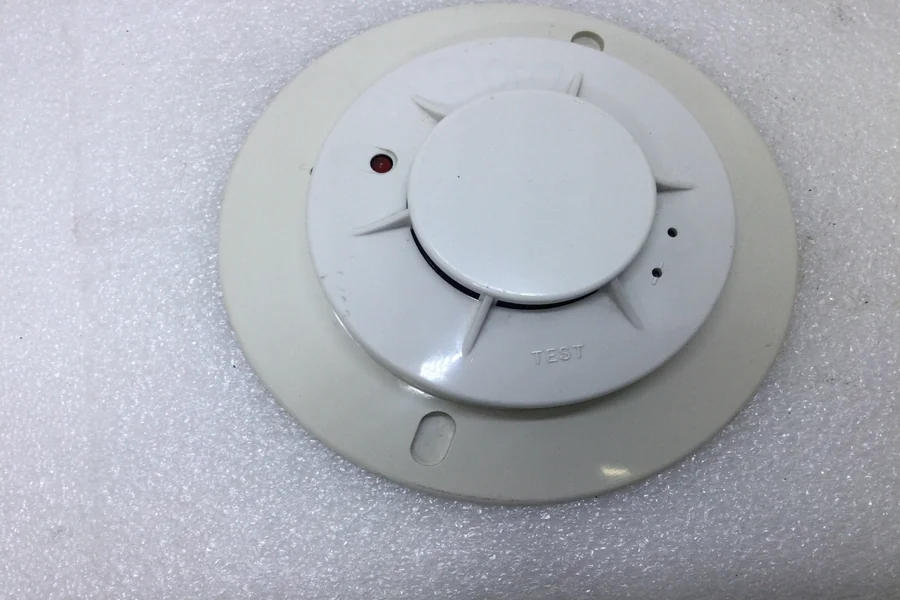
In the intricate minefield of fire safety, choice of detection technology is always a matter of life and death. They say smoke detectors are usually the first line of defense, but they can rarely get the job done if smoke is a mere byproduct of business or if the fires grow in lethal intensity before any smoke can be generated. The Fenwal heat detector thus comes into action, and very importantly so. Designed for ruggedness and endowed with advanced rate-compensation technology, the Fenwal heat detectors provide a very fine degree of discrimination in the activation of fire suppression and alarm systems in a timely and reliable manner even in very hostile industrial and commercial environments.
The Science Behind Fenwal’s Dual-Action Technology
Heat detection in the highest level Fenwal technology means what the historical DETECT-A-FIRE® mechanism has done and continues to do over the decades: unlike the simplistic fixed temperature detectors that activate once a particular temperature is reached or the basic rate-of-rise detectors, which are prone to false alarms due to abrupt temperature changes with no fire involved, the Fenwal detectors combine both concepts. The rate-compensation feature of the Fenwal detector enables it to measure the temperature of the surrounding air accurately and impartially, irrespective of how fast or slow the fire is developing, thus striking the best possible balance between responding quickly to fast-growing fires and denying false alarms from slow temperature increases that will not contribute to any hazardous situation. When used with a conventional fire alarm panel, the output from these detectors become virtually fool-proof initiators of critical safety actions.
Mechanical Ingenuity for Unmatched Response
The brilliant mechanical design of the DETECT-A-FIRE detector employs two heat-sensitive elements: an outer shell constructed of a fast-expanding alloy material and inner struts fabricated from an alloy material with a slower rate of expansion. In a slow-burning fire, both the outer shell and the inner struts heat up relatively uniformly, and when ambient air temperature reaches the detector’s preset temperature level, the internal contacts close to signal a fire condition. However, in a fast-developing, aggressive fire, the outer shell heats and expands much faster than the inner struts. This quick differential expansion practically closes the internal contacts, enabling almost immediate alarm or suppression system actuation. By making use of this dual action, no matter whether the fire is slow smoldering or explosive, the Fenwal detector will respond accurately and without delay.
Versatility Across Challenging Environments
Such precision makes Fenwal very versatile and, thus, an indispensable element of many applications. They are normally utilized in areas where smoke detection is cumbersome, unreliable, or even downright not wanted. Among others, such places include commercial kitchens, where cooking fumes could lead to nuisance alarms; dusty manufacturing plants; paint spray booths, with airborne particulates; engine rooms for vehicles or marine vessels; and areas with very high ambient temperatures, such as boiler rooms or industrial ovens, where ordinary smoke detectors would have no chance of functioning properly. They are also highly suited to situations in which the speed of fire growth must be tracked precisely in an effort to stave off possibilities for significant damage or explosion hazards.
Durability and Cost-Effectiveness: Designed for Reliability
Besides the accurate detection offered by these devices, great value is also put on Fenwal heat detectors for their ruggedness and the fact that they require minimal maintenance. With these detectors rugged, corrosion-resistant outer shells are usually found; they are adequately built to tolerate severe environmental conditions, including shock, vibration, and even corrosive atmospheres (with special coatings available). Another very big advantage is that of self-resetting. The detector sets itself back to ready once the temperature returns to normal following a non-fire-related thermal excursion, thus eliminating the need for manual resetting or expensive replacement after relatively minor thermal excursions. This inbuilt reliability and repeatability makes them low-cost yet effective long-term protection for fire.
Conclusion: Engineering Excellence in Fire Safety
In conclusion, when a plant need of Fenwal heat detectors means safety based on temperature rate or measuring rate of fire growth so as to provide timely counteraction, then the Fenwal heat detector stands as an example of high engineering applied to fire protection. It forms the heart of any fire protection approach, giving assurance of activating alarms and suppression systems with very high accuracy because they were ruggedly constructed around this breakthrough rate compensation technology.