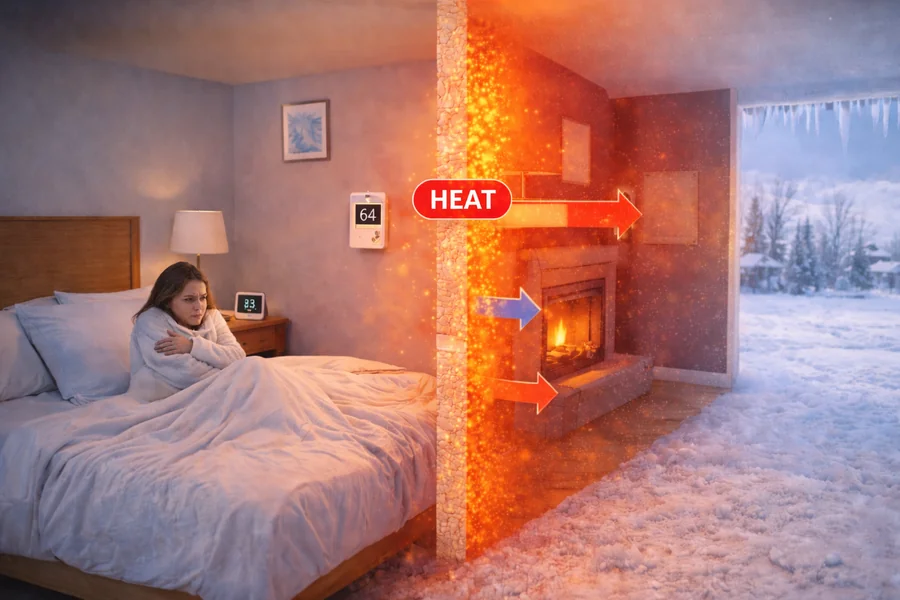
A bonus room over the garage that runs eight to ten degrees colder than the rest of the house is rarely a dying furnace. It is a sizing and duct problem, and both of those are measurable. For a homeowner in a 1970s Chester split-level, a heating repair chester va visit that opens with airflow readings and duct measurements will normally land on a fixable cause: a branch duct too small for the load, or a control strategy that hands the whole evening over to electric strip heat. Here is the argument in one line. Measuring what the equipment you already own can deliver costs far less than replacing it, and on a finished room addition the measurement usually points at a repair.
Added Square Footage Rarely Comes With Added Capacity
Start with what the house was built to hold. Say the original conditioned space came to about 1,650 square feet on a 36,000 BTU heat pump, which is roughly 22 BTUs per square foot of design capacity. Finish 380 square feet over the attached garage and that same equipment now answers for 2,030 square feet, or about 17.7 BTUs per square foot. In a bedroom in the middle of the house, that gap would be survivable. Over a garage it is not, because the room bleeds heat through a floor with outdoor air moving underneath it, through knee walls, and through a ceiling that shares an unconditioned attic. Job after job, the shortfall shows up worst in exactly that one room and nowhere else, which is the clue that the outdoor unit is probably fine.
Duct Sizing Decides More Than Equipment Size Does
Duct capacity behaves like the turnstiles at a stadium. You can seat forty thousand people, but the building empties at the speed of the gates, not the speed of the seats. Ductwork is the gate. A single 6-inch flexible run moves on the order of 100 cubic feet per minute at normal residential static pressure, and a 380-square-foot room sitting over unheated space wants closer to 150 or 160. One undersized run, taken off a trunk that was already at its limit, will starve that room no matter how big the equipment outside gets.
Static pressure readings tell the same story from the other end. A blower fighting a restriction moves less air everywhere, so the far room stays cold while the rooms near the air handler overshoot and the thermostat keeps calling for heat the house does not need. In practice this usually means a technician can close out the complaint with a resized branch and a blower speed change rather than new equipment. That is a few hundred dollars of labor and sheet metal against a five-figure quote.
Strip Heat Is The Expensive Way To Cope
Electric strip heat exists so a heat pump has something to lean on when outdoor temperatures drop past what it can cover alone. It works. It is also the most expensive heat in the building, returning roughly one unit of heat per unit of electricity where the heat pump itself returns two or three. When one cold room keeps the thermostat calling all evening, those elements run hours they were never designed to run, and the electric meter does not lie.
The U.S. Energy Information Administration, in its Electricity Monthly Update for May 2026, put the commercial sector’s average retail electricity price at 13.54 cents per kilowatt-hour, up 4.7 percent from May 2025. That series tracks commercial accounts rather than houses, so read it as direction of travel and not as your own rate. A heating repair chester va call in January should therefore begin with runtime and wattage questions instead of a replacement quote. Strip heat is not a heating system, it is the bill for capacity the ductwork never delivered.
A Tripping Air Handler Breaker Is A Stop Sign
A second trip on the air handler breaker changes the conversation completely. Electric auxiliary heat pulls hard, often 15 to 20 kilowatts across sequenced elements, and that load shares a circuit with the blower. A breaker that opens under it is doing its job, which means something on the other side of it has failed: an element shorting to its frame, a loose lug, a tired breaker, or a sequencer stuck closed.
Stop resetting it, and do not open the panel or the air handler cabinet to look. The Electrical Safety Foundation International lists frequent breaker tripping and blown fuses among the warning signs of an overloaded, hazardous electrical system, and 2 trips on the same circuit inside 6 weeks is frequent by any reading, so leave that circuit off and have a licensed technician find the cause before it is energized again.
Repair Math Beats Replacement Math More Often
Put illustrative numbers on both roads and the decision tends to make itself. Say a measured diagnostic runs $150, a resized branch with a corrected takeoff and a new register lands near $900, and a blower and control correction adds $250, which comes to $1,300 all in on the repair path. Replacing the heat pump and air handler on this house is a different order of magnitude, call it $9,000 to $12,000 installed, and none of that money widens a 6-inch duct that still cannot carry 150 CFM to the bonus room. (Nobody enjoys hearing that the expensive box outside was never the problem.) The repair path is also the one that moves the monthly number, because dropping strip runtime from four hours a night to under one on a 15 kilowatt bank is the gap between a rough winter bill and an ordinary one.
One Measured Diagnostic Settles The Whole Argument
Every figure above rests on measurement rather than opinion, which is the whole point of starting with a diagnostic. Static pressure at the air handler, airflow at the bonus room register, temperature split across the coil, amp draw on the strip bank: those readings take under an hour and they name the fault instead of guessing at it. What they most often show on a 1970s split-level with a finished room over the garage is a system carrying enough capacity and not enough duct. Correct the duct and the control logic, and the room holds its setpoint on the heat pump alone, which is where the savings actually live. Ask for the readings before anyone quotes equipment, and the argument about replacing a working system usually ends right there.