When the anthem plays, the world stops. But behind the magic of European nights lies a complex dimension of engineering, data, and psychological design.
There is a specific frequency to a Tuesday or Wednesday night in Europe. It begins with the rustle of a colossal nylon banner in the center circle and ends with the crescendo of a choir singing in three languages. The UEFA Champions League is not just a tournament; it is a brand, a ritual, and a sensory experience designed to induce a state of pure footballing “Zen.”
For the broadcaster, the Champions League represents the pinnacle of production. It is the “Dimension Zen” of sports—a place where the chaos of the game meets the perfection of presentation. Every camera angle is mandated, every graphic is polished, and every audio feed is mixed to spine-tingling perfection. This article deconstructs the invisible architecture that turns a simple football match into the most watched club competition on Earth.
The Uniformity of Excellence
Unlike domestic leagues, where production quality can vary from stadium to stadium, the Champions League mandates a strict “World Feed” standard. Whether the game is in Madrid, Munich, or Manchester, the visual language is identical.
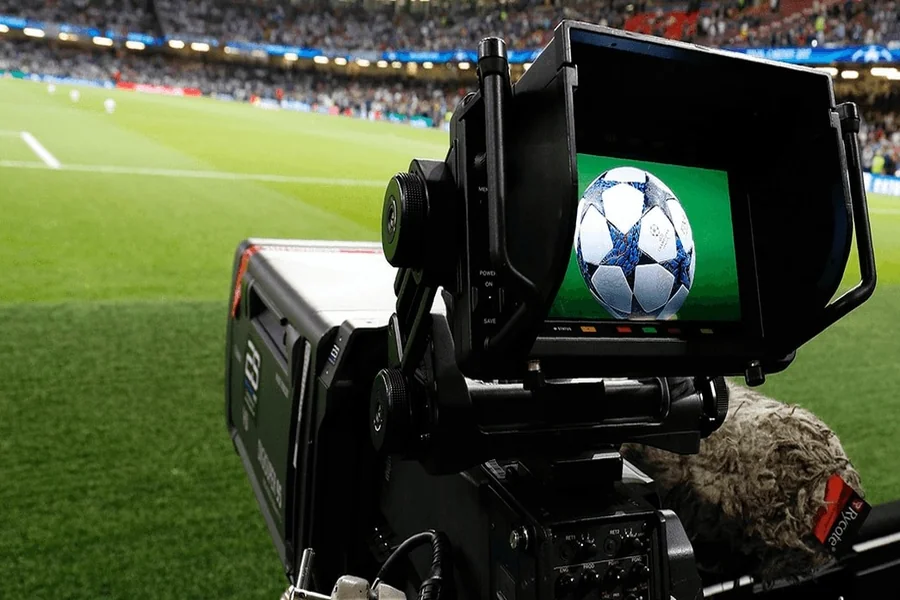
This requires a massive logistical operation. UEFA creates a “master signal” that is distributed globally. This signal is 4K, HDR (High Dynamic Range), and increasingly, immersive audio. The goal is to create a visual consistency that triggers a Pavlovian response in the viewer. The moment you see the starball logo and the specific color grading of the broadcast (a distinct, cool blue-silver tint), your brain knows you are watching the elite.
Achieving this consistency requires cutting-edge hardware. The cameras used are often higher spec than those used in Hollywood films, capable of capturing the sweat on a player’s brow in super-slow motion without motion blur. This visual fidelity is crucial for maintaining the “premium” feel of the product.
The Audio Landscape: Capturing the Roar
The visual is only half the story. The sound of the Champions League is its soul. Audio engineers place microphones not just on the sidelines, but in the crowd, on the goalposts, and sometimes even buried in the pitch.
The mix is designed to be immersive. When a goal is scored, the engineer pushes the “crowd fader” up, drowning out the commentary for a few seconds to let the viewer feel the raw energy of the stadium. This audio manipulation transports the viewer from their living room into the stands. It is a form of acoustic teleportation.
The Global Distribution Challenge
Broadcasting the Super Bowl is hard, but it’s mostly focused on one country. The Champions League must serve 200+ territories simultaneously. This distribution network is the nervous system of global football.
The signal travels from the stadium to a satellite, then to distribution hubs, and finally to local broadcasters. In the era of streaming, this path has become digital. The challenge is ensuring that the stream remains stable and high-definition as it crosses oceans and firewalls.
In tech-forward markets like South Korea, the expectation for this quality is non-negotiable. Fans are not just watching; they are analyzing. They demand a feed that supports the high-resolution displays they own. This has led to the rise of premium access hubs. Platforms identified by users as 강남티비 serve as critical nodes in this network. They act as the digital gateway for fans who refuse to compromise on quality. By providing a direct, stable link to these massive European files, they ensure that the integrity of the “master signal” is preserved all the way to the viewer’s screen in Seoul.
The Data Dimension
Modern broadcasting is a hybrid of video and data. The “starball” graphic that floats over the pitch showing player distances is not an animation; it is a real-time visualization of data.
Optical tracking systems map the players’ movements 25 times a second. This data is processed instantly to generate insights: “Who is the fastest player tonight?” “Which team is pressing higher?”
This data feeds the curiosity of the modern fan. We are no longer satisfied with just watching the play; we want to understand the geometry of the play. The broadcast gives us this analytical dimension, layering intelligence over emotion.
The “Real-Time” Imperative
The Champions League is best served live. The drama of a last-minute winner or a penalty shootout loses its potency if you know the result beforehand.
This drives the relentless search for low-latency streams. The term 실시간중계 (real-time broadcasting) is more than a keyword; it is a technical demand. It represents the fan’s need to be synchronized with the rest of the world. In a global tournament, being 30 seconds behind means your phone buzzes with a spoiler before you see the goal. Fans actively seek out platforms that offer true real-time performance to protect the sanctity of the live experience. They want to be in the “now,” sharing the collective gasp of the world at the exact millisecond it happens.
The Psychology of the Night Match
There is a psychological reason why Champions League matches are played at night. Under the floodlights, the grass looks greener, the kits look sharper, and the stadium feels like a theater. The darkness outside the pitch focuses the attention.
Broadcasters lean into this. They use lighting and contrast to isolate the players, making them look like gladiators in an arena. It is a deliberate aesthetic choice to heighten the drama.
The Theater of Dreams
Ultimately, the technology behind the Champions League is designed to disappear. The cameras, the satellites, and the data processors are all there to serve a single purpose: to create an unblemished stage for the world’s best athletes.
When we tune in on a Tuesday night, we are entering a carefully constructed dimension of excellence. The tech ensures that nothing gets in the way of the football. It allows us to attain that state of “fan Zen”—where the world fades away, and all that matters is the ball, the goal, and the glory. The broadcast is the vessel; the game is the spirit inside it.