Children are wired to learn through play. That is not a soft sentiment – it is how the developing brain builds the circuitry for attention, memory, and self-regulation. Adele Diamond, one of the most cited researchers in developmental cognitive neuroscience, has spent two decades showing that the “executive functions” underlying focus and learning grow strongest when children practice them inside games that are challenging, playful, and repeated often.
You do not need a curriculum or a screen for this. You need seven old games, a small amount of time, and a reason to keep coming back to them.
1. Simon Says (inhibitory control)
Researchers have used Simon Says variants – like the “Head-Toes-Knees-Shoulders” task developed by Megan McClelland and colleagues – to measure and train the ability to hold back an automatic response. That ability, called inhibitory control, predicts kindergarten readiness and math skills years later.
How to play it well: speed up gradually, add rule-switches (“today, when I say touch your nose, touch your ears instead“), and keep rounds short. The switch is where the executive function work happens.
2. Memory Match (working memory)
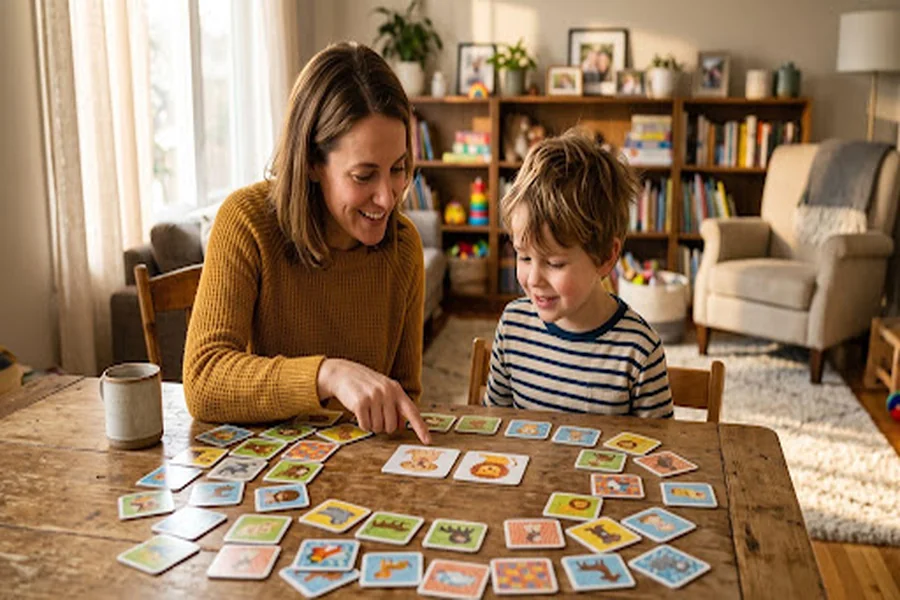
Turn all the cards face down, take turns flipping two at a time, keep the pairs you find. Simple – and a clean workout for working memory, the mental workspace where a child holds information while doing something with it. Working memory is one of the three core executive functions and correlates strongly with reading comprehension and math performance across school years.
How to play it well: start with 6 cards for younger children and add pairs as they master each size. Talk out loud on your turn (“I saw the dog card near the top”) – you are modeling the strategy their brain will eventually run silently.
3. Freeze Dance (self-regulation and auditory processing)
Music on: everyone dances; music off: everyone freezes. The Tools of the Mind curriculum – one of the few preschool programs with randomized-trial evidence of measurable gains in executive function – uses freeze games as a core mechanism because they combine three things: sustained attention to an external cue, motor inhibition, and cognitive flexibility when the rules change.
How to play it well: after a few rounds, flip the rule. When music plays, freeze; when it stops, dance. That rule flip is the moment cognitive flexibility gets built.
4. “I Went to the Market” (sequential memory)
Take turns adding an item to a list, and each player has to recite everything that came before. “I went to the market and bought an apple.” “…an apple and a banana.” “…an apple, a banana, and a lion for some reason.”
This is sequential working memory practice with a natural progression built in – the game gets harder as it goes. Researches in developmental psychology consistently link stronger verbal working memory to stronger reading and language outcomes.
How to play it well: let the categories drift silly. Absurd items are easier to remember, which means your child experiences success and asks for another round. That is the whole loop.
5. Kim’s Game (attention and encoding)
Put 10 small objects on a tray. Let your child study them for 30 seconds. Cover the tray. Ask what was on it. For a harder version, remove one object while their eyes are closed and ask which one is missing.
Named after the Rudyard Kipling character trained in observation by a jeweler in Lahore, Kim’s Game has been used in Scout training for a century because it works on two mechanisms at once: sustained attention and encoding – turning what you see into something memory can hold onto.
How to play it well: narrate the strategy after each round. “I noticed you grouped the small things together.” Teaching a child to notice their strategy is what turns a game into a durable cognitive skill.
6. Cross-Crawl Clap Patterns (bilateral coordination)
Stand facing each other. Clap your own hands, then clap your right hand to your child’s right hand, then clap your own hands, then left-to-left. Then reverse. Then speed up.
Cross-lateral movements engage both hemispheres of the brain at once and support the corpus callosum, the bundle of nerves connecting the two halves. Occupational therapists rely on bilateral coordination games because the same cross-body communication later underlies handwriting, reading, and coordinated sport.
This is one of the best games to reach for as an easy brain break for kids between focused tasks – three minutes of clap patterns can visibly reset a child’s ability to sit back down and pay attention.
7. Balance and Think (dual-task processing)
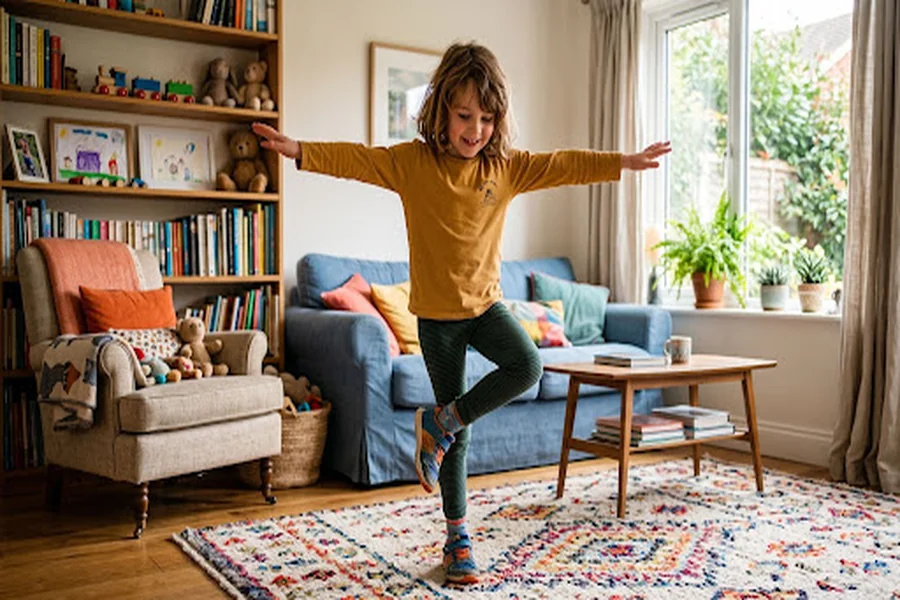
Stand on one foot. Now count backwards from 20. Or say every animal that starts with B. Or recite the days of the week backwards.
Dual-task balance games ask the cerebellum (balance) and the prefrontal cortex (working memory and language) to coordinate under mild challenge. A growing body of pediatric neuroscience indicates that physical activity engaging balance and coordination is a meaningful factor in the development of childhood executive function.
How to play it well: switch feet after 30 seconds. Add a small wobble challenge (eyes closed) only when the balance itself is easy.
Making it stick
7 games are more than any family needs in a week. The idea isn’t to run them like a syllabus – it’s to have enough options that one always fits the moment. A checked-out child after school needs Freeze Dance, not Kim’s Game. A restless car ride is a natural Memory Match or “I Went to the Market” moment.
Two principles separate the families who see change from the ones who lose the thread by week two.
Match the game to what the brain is asking for. A bouncing child needs a big-motor game. An unfocused child needs inhibitory control or bilateral movement. An overloaded child needs connection, not a game at all.
Short and daily beats long and occasional. Five to ten minutes a day, six days a week, will do more for a child’s attention and memory than a two-hour session on Saturday. Consistency is the active ingredient in every study cited above.
For parents who prefer a plan to a mental checklist, brain games for kids from Leaply can also be delivered as a short daily practice sequenced around your child’s age and where they need the most support. The format matters less than the daily habit – a printed list on the fridge works too. What matters is that tomorrow the small game happens again.
Just one game a day, seven days in a row. By week three, you’ll start noticing the shifts. That is where the neuroscience actually shows up – not in a single afternoon, but in the quiet accumulation of small, playful reps.